


‘I don’t feel like myself anymore.‘
Have you ever said this? Especially as a mom in early motherhood. Not in a dramatic way. Not in a way that’s easy to explain. But in the quiet, everyday moments — something feels off.
You’re going through the motions. Getting things done. Showing up where you need to. From the outside, it probably looks like you’re handling it.
But inside, there’s a disconnect.
You don’t feel as present. As clear. As connected to yourself as you used to. Things that used to feel like you — your personality, your energy, your way of being — feel harder to access now.
And every now and then, that thought comes up: ‘Who even am I right now?‘
There’s a kind of confusion that sits underneath it. And if you’re honest, a quiet grief too. Not always loud, not always obvious — but there. Because you remember who you were before you became a mom. And this… doesn’t fully feel like her.
I’m a therapist and coach, and for the past 15 years I’ve worked with women of color navigating postpartum, matrescence, and early motherhood. I’m also a mother myself. And this is one of the most common things I hear from the women I support:
“I don’t feel like myself anymore.”
And here’s what I want you to know: You didn’t completely lose yourself, even thought it feels like it.
There’s a reason this is happening.
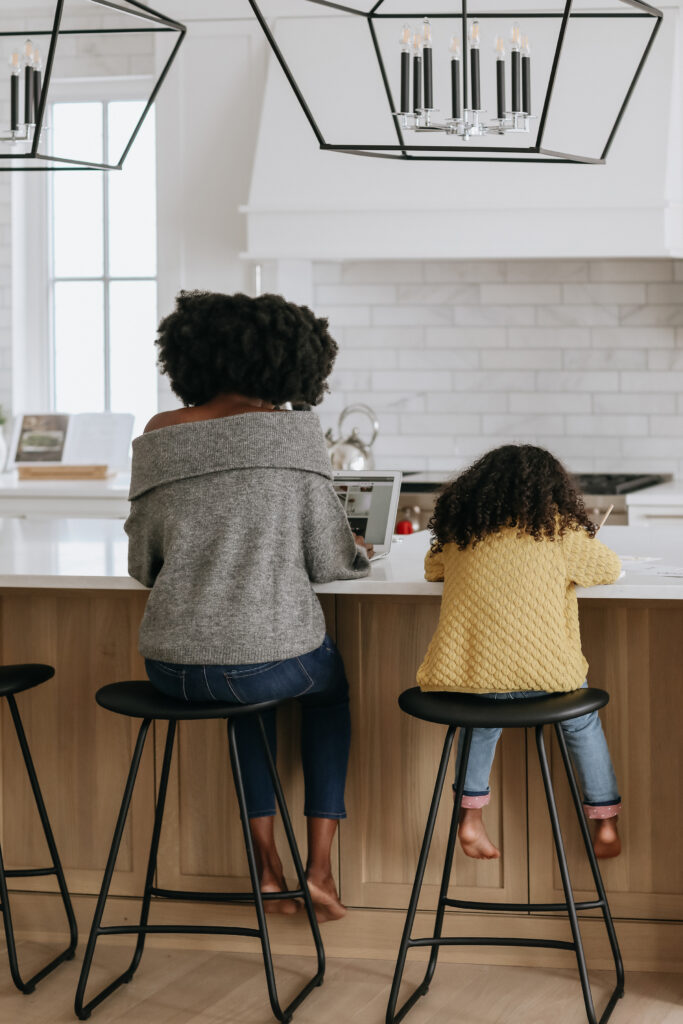
It Doesn’t Feel Like You — And That’s What Makes It So Hard
What makes this so hard isn’t just how you feel. It’s that it doesn’t feel like you.
You remember the version of yourself who felt more present. More connected. More like you were actually inside your life instead of just moving through it. Maybe there was more ease in how you showed up. More access to your personality, your joy, your energy.
And now… something feels different.
You still show up. You still handle what needs to be handled. But it feels more like survival than living. There’s less room for joy. Less connection to yourself. Less space to just be.
And the thing is, it’s not that everything is bad. You love your children, maybe you even love being a mom, and mothering. It’s that something feels missing.
And that’s the part that’s hard to explain — because from the outside, it might not look like anything is wrong. But internally, there’s this quiet awareness: this doesn’t feel like me.
Why It Feels Like You Need to Find Yourself Again
When you feel this disconnected from yourself, the natural response is to try to fix it.
You start thinking:
I need to do more for me.
I need better balance.
I just need to get back to myself.
And on the surface, that makes sense.
Because it does feel like you’ve lost something. Like parts of you are harder to access, or further away than they used to be. So of course the instinct is to go looking for them.
But this is where things get misunderstood.
You didn’t lose yourself. Your identity didn’t just disappear.
It adapted.
It shifted under pressure — shaped by the demands of motherhood, the pace of your life, and everything you’ve had to carry.
So instead of being something you simply “find” again, your identity is something that has been responding to what your life has required of you.
And that’s a very different starting point.
What’s Actually Happening to Your Identity
Your identity didn’t disappear, but it is being reshaped by the season you are in, especially if you are in early motherhood, postpartum, or in the early years of matrescence.
What you’re experiencing isn’t random, and it’s not a personal failure. It’s the result of multiple layers of change happening at the same time, often without the support needed to make sense of them.
Survival Mode Prioritizes Function Over Identity
When your life requires you to keep going, identity becomes secondary. You focus on getting through the day, meeting needs, handling what’s in front of you. There isn’t much room to think about who you are when so much of your energy is going toward what has to get done and who needs you. Over time, you stop relating to yourself as a person and start relating to yourself as a function.
Depletion Leaves No Capacity for Selfhood
Identity work requires energy. It requires space to think, feel, reflect, and connect with what you want. But when your body is depleted and still recovering from birth, breastfeeding, and postpartum— physically, mentally, emotionally — that capacity just isn’t there. You’re not thinking about your desires because you’re trying to heal and make it through the day. It’s not that you don’t have a sense of self. It’s that you don’t have the capacity to access it.
Matrescence Is Rewiring Who You Are
At the same time, you are going through a real identity shift. Matrescence is the process of becoming a mother, and it changes how you see yourself, your priorities, your relationships, and your place in the world. There’s expansion happening too — new roles, new awareness, new parts of you emerging. But there’s also loss. Parts of your old identity don’t fit in the same way anymore. And holding both of those at once can feel disorienting. You are becoming someone new while grieving who you were.
Culture Shapes How Much of Yourself You’re Allowed to Keep
For many women — especially Black women — identity doesn’t exist outside of cultural expectations. The “strong Black woman,” the good mother, the one who holds everything together and doesn’t drop the ball. The pressure to not fail, to carry more, to be everything for everyone. Those expectations don’t just influence what you do — they influence what parts of yourself you feel allowed to prioritize, express, or even keep.
And when you’re raising children — especially Black children — there’s another layer of responsibility and awareness.
There’s vigilance. There’s the pressure to get it right, to protect, to prepare, to navigate a world that doesn’t always feel safe. That level of responsibility can push even more of your own needs and identity to the side, not because they don’t matter, but because survival and protection take priority.
And when all of this is happening at the same time, it creates a very specific kind of tension. Parts of you are being stretched — asked to grow, shift, and become someone new.
While at the same time, your life is asking you to shrink — to focus, to function, to put yourself aside in order to keep everything going.
So you end up in this in-between space. Wanting more for yourself, while not having the capacity to hold it yet.
That’s part of what makes this feel so disorienting.
Why You Can’t “Just Focus on Yourself” Right Now
At some point, you’ve probably heard some version of this:
“You just need to focus on yourself more.”
“Take time for you.”
“Do more of what fills you up.”
And while that sounds good in theory, it often doesn’t land in a way that actually helps. Because the reality is — your life may not have the kind of space that advice assumes.
You can’t always just step away. You can’t always create long stretches of uninterrupted time. You’re still needed. There are still responsibilities, demands, and people depending on you.
So when you try to “focus on yourself” without the support to make that possible, it can start to feel like one more thing you’re not doing well enough.
Not because you’re doing it wrong. But because the advice doesn’t match your reality.
And this is where the shift happens.
The kind of identity and sense of self work that actually helps you feel like yourself again doesn’t happen by trying to carve out more from an already full life.
It happens when you’re supported within it.
When your body has what it needs. When your capacity is built back up. When there’s enough steadiness for you to reconnect with yourself in a way that actually sticks. Because this isn’t about escaping your life to find yourself.
It’s about being supported enough to feel like yourself inside it.
What Actually Helps You Feel Like Yourself Again
So if the answer isn’t to just “find yourself” again… what actually helps?
It starts with understanding that this isn’t something you jump straight into. You rebuild. And you rebuild in a way that actually supports where you are right now.
In my work with moms, that begins with your body.
Making sure you have what you need at the most basic level — sleep where possible, consistent nourishment, hydration, and reducing some of the constant output so you’re not always running on empty. Because when your body has more to work with, you have more capacity to hold your life.
From there, you build that capacity.
Not by doing more, but by creating enough regulation in your day-to-day so you’re not constantly in survival mode. That might look like somatic work, small boundaries, creating a little more space where you can, or having moments where you’re not immediately responding to everything around you.
And then, over time, you begin to reconnect.
With what you need. What you want. What matters to you now. Not who you used to be, but who you’re becoming in this season of your life.
Because this isn’t about going back. You don’t find yourself.
You rebuild yourself.
What Changes When You Feel Like Yourself Again
When you start to feel like yourself again, it’s not always loud or dramatic.
It’s subtle at first — but you notice it.
You recognize yourself in the way you think, the way you respond, the way you move through your day. You feel more connected, not just going through the motions or getting things done, but actually present in your life.
You begin making decisions from a place that feels like you, not just from what needs to happen or what everyone else needs from you. There’s a sense of choice again, instead of just reacting to what’s in front of you.
And underneath it all, there’s a feeling of wholeness.
Not perfection. Not having everything figured out. But not feeling as split, as disconnected, or as far away from yourself as you once did.
Because the truth is… you didn’t disappear.
You Didn’t Lose Yourself — You’ve Been Carrying a Lot
If you’ve been feeling like you don’t recognize yourself anymore, I want you to come back to this: you didn’t disappear.
Nothing about this is random, and it’s not a reflection of your worth, your capability, or who you are as a woman or a mother.
Your identity has been shaped by what you’ve been carrying.
The demands of early motherhood. The reality of matrescence. The lack of support in postpartum recovery. The pressure to hold everything together, to be strong, to not drop the ball. The responsibility that comes with raising children — especially in a world that asks more from you than it gives back.
Of course parts of you feel further away. Not because they’re gone.
But because they’ve had to take a step back in order for you to survive what this season has required. And the truth is — you don’t find your way back to yourself by trying harder or doing more on your own.
You rebuild.
With support. With capacity. With intention.
That’s the work I do with mothers navigating postpartum, matrescence, and early motherhood — helping you move out of survival mode and depletion, and into a way of living where you feel connected to yourself again, not just functional in your life.
So if you’re ready for that kind of support, I invite you to take the next step.
Book a call to explore what it would look like to work together.
You don’t have to keep feeling like you’ve lost yourself.

Comments +